Virtual plant simulations of Africa
EcoSISTEM was designed to scale to much larger areas, supporting many more species. As an illustrative example, here we simulate up to 50,000 plant species over Africa, with a constant background environment. When all species are given an equal fitness in the habitat, all 50,000 can co-exist over long time scales of over 100 years (Figure 2A). This can be run on a workstation with 24 threads in just under 5 hours.
We can also explore the behaviour of selective advantage of specialist species over generalists at these scales. When we introduce a specialist species into an African-sized landscape with an existing generalist, the specialist out-competes the generalist and spreads throughout the continent. The larger the selective advantage of the specialist, the faster it is able to invade and colonise across the landscape (Figure 1). These same dynamics can be seen when we introduce a specialist to the full complement of 50,000 species (Figure 1B-D).
Running it
The code for these simulations is examples/HPC/Africa.jl. It is a script rather than a listing on this page, and deliberately so: a page of code that nothing runs stops working without anyone noticing, and this one had - it was still written against builders that were deprecated and against a geographic grid a simulation now refuses.
# a smoke test in seconds, at 100 km cells
ECOSISTEM_SCALE=small julia --project=examples examples/HPC/Africa.jl

# the real thing, resolution chosen from the memory available
julia -t 8 --project=examples examples/HPC/Africa.jl

# across MPI ranks, on a cluster
mpiexecjl --project=examples -n 32 julia -t 8 --project=examples examples/HPC/Africa.jl
It chooses its own resolution
The grid is not fixed. examples/HPC/memory.jl works out how much memory the run can allocate - summed across every node when it is launched under MPI - and the script takes the finest Africa grid that fits, from 100 km down to 5 km. Nothing about the cost is written down: investigate_study_area resolves a candidate grid without building it, and EcoSISTEM.getspeciesstorage says what one species' abundances would occupy on it.
At 50,000 species that spans a few GiB on a laptop to several TiB across HPC nodes, so the same file serves both. 5 km is multi-node only.
At these sizes a single recorded timestep can be tens of GiB - more than the run itself holds per rank. The script therefore defaults to keeping nothing, with a JLD2 file at a regular interval or on specific dates as opt-ins. See simulate!, SaveAbundance and AtDates.
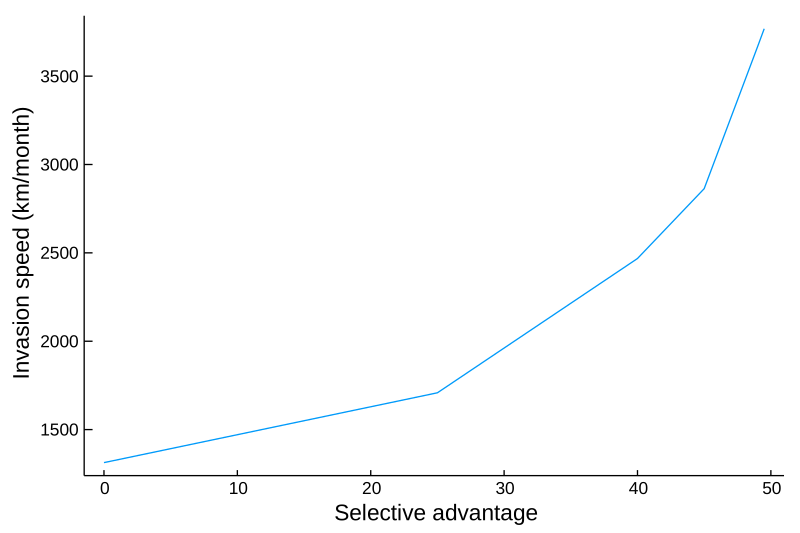
Figure 1: invasion of a specialist against generalists, and its speed as a function of selective advantage.
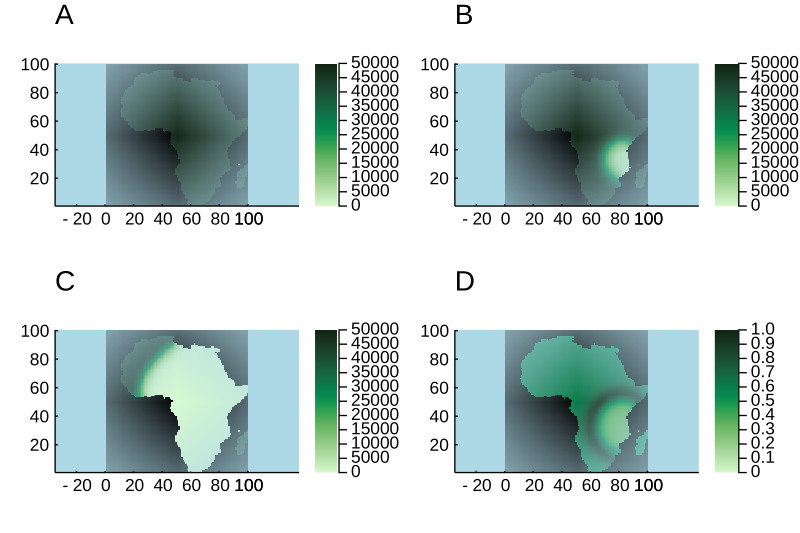
Figure 2: 50,000 species coexisting across the continent.
Smaller examples of the same machinery
Africa is the scaling demonstration. Each of the pieces it uses is shown on its own, at a size that runs in seconds, in examples/:
| what | where |
|---|---|
| a fully synthetic ecosystem, no downloads | examples/SimulatedEcosystem.jl |
| real raster + real shapefile coastline | examples/ScottishCultivatedLand.jl |
| composing layers into a new axis | examples/AvailableGround.jl |
| a climate that warms, and one that cycles | examples/VaryingClimate.jl |
| categorical land cover and class-set niches | examples/CategoricalLandCover.jl |
| the same ecology under five landscapes | examples/landscapes.jl |
| climate change, habitat loss and invasion | examples/interventions.jl |
For an interactive version you can drive from a browser, see the notebooks/InteractiveAfrica.jl Pluto notebook, which runs a much smaller Africa and lets you move the species' temperature preference with a slider.